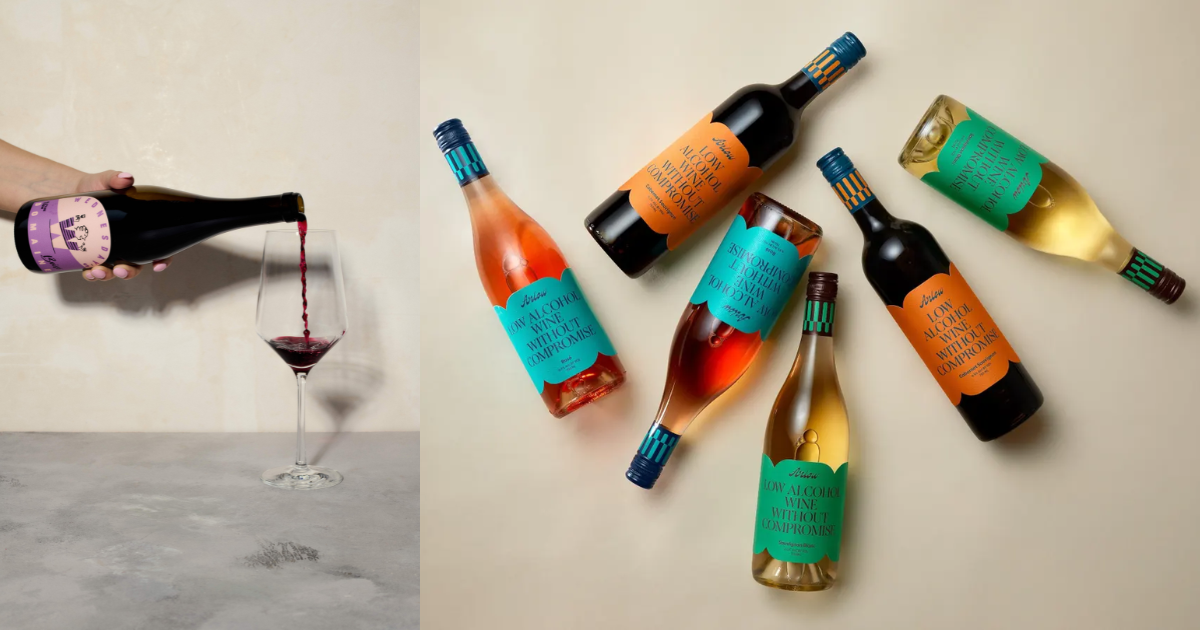
Two non-alc wine brands, years into operating exclusively <0.5% ABV, both decided to add alcohol. Wednesday’s Domaine recently launched a 6.5% ABV range under its existing brand. In 2024, Brandon Joldersma, CEO of Surely, launched Arlow as a separate low-ABV brand. They made the same bet and structured it in opposite ways. The split reveals two different strategies for capturing new demand.
The two approaches
Wednesday’s Domaine extended its existing brand across the ABV spectrum, while Joldersma kept Surely non-alc and launched Arlow as a distinct brand. One bets that a single brand identity can stretch across the ABV spectrum; the other bets that the moderating consumer and the low-ABV consumer are different enough to warrant separate front doors.
The trade-off is clear. A spectrum-under-one-name approach compounds brand equity and lets a loyal non-alc customer trade up without leaving—but it carries positioning dilution risk if buyers can’t reconcile the range. A separate-brand approach protects the integrity of the non-alc flagship and gives the low-ABV brand its own positioning freedom—but it forfeits the equity transfer and doubles the brand-building burden. Neither is obviously right. The choice depends on whether an operator believes the key asset is the brand or the occasion.
The bridge problem underneath the move
These brands’ moves trace to a tension Dry Atlas has been tracking. Earlier this year, we argued that non-alc wine may function as a transitional bridge rather than a long-term beverage habit: strong trial, weak repeat, and consumers who migrate toward other formats as their preferences mature. The key question was whether a brand is building for transition behavior or long-term beverage identity.
Wednesday’s Domaine founder Luke Hemsley’s account of the 6.5% decision reads as a direct answer to that tension—though not one a pure non-alc thesis would predict. He describes the brand as never having been built on absence in the first place: “It was built around a shift we felt was happening in culture: people still loved wine, the ritual, and gathering but increasingly wanted more say over how they drank.”
The ABV spectrum began to blur. “We kept meeting people who weren’t sitting at either end. They weren’t saying ‘I want alcohol’ or ‘I want no alcohol.’ They were saying ‘I want to feel good tomorrow and still enjoy tonight.’” The 6.5% range is an attempt to hold that consumer inside the brand rather than watch them migrate out of it. As Hemsley frames it, the move “wasn’t a departure from the original idea, it was a natural evolution.”
This is the bridge problem solved from the supply side. If consumers decouple from the non-alc analog over time, one response is to engineer better craving architecture inside 0.0%. Another is to widen the offer—whether under one brand or two—so the migration happens within the operator’s portfolio instead of away from it.
Occasion as the organizing logic
For Wednesday’s Domaine, the spectrum-under-one-name structure only holds if the brand’s organizing principle isn’t ABV. Hemsley is explicit that it isn’t, and that the promise didn’t move when alcohol entered the range. “Our promise hasn’t changed at all. If anything, it’s become clearer. We don’t think of ourselves as a non-alcoholic brand that added alcohol. We think of ourselves as a modern wine for modern times.” He frames the two formats as serving the same mindset across different moments: “0.0% gives people the confidence of clarity. 6.5% gives people the freedom of balance. Different moments, same mindset.”
Hemsley’s take aligns with the ABV optionality trend Dry Atlas has tracked since 2023, and it matches what mature on-premise accounts already do. Hemsley notes that hospitality grasped this instinctively: in Michelin rooms, “it isn’t framed as ‘here’s the non-alcoholic option.’ It’s framed as another considered choice on the wine list and something guests actively choose because it suits the moment.” He sees the same pattern at retail, where shoppers “are no longer buying into binary identities like drinker or non-drinker. They’re buying for occasions, moods, and tomorrow morning.”
That’s where the two structures diverge in risk. A spectrum brand needs buyers to organize by occasion; if they organize by ABV, the range reads as two products fighting for one shelf position. A separate brand sidesteps the question by giving each ABV band its own identity. The choice is, in part, a bet on how much buyer behavior an operator wants to depend on.
Why 6.5% and not lower
Hemsley says the brand explored several directions before landing on 6.5% as the point with “enough structure, aroma, and body to feel like wine while maintaining enough lightness to create the new drinking experience people are looking for.”
It also reframes what these brands are selling. The concern with <0.5% is that removing ethanol removes the reinforcing mechanism, leaving ritual without craving. A low-ABV wine reintroduces a real, if reduced, taste complexity and physiological effect—which is precisely what a transitional consumer migrating away from non-alc analogs may be reaching for.
What operators should take from this
The move surfaces a decision for operators: whether the brand is a non-alc brand or an occasion brand that happens to have started at zero. Those are different businesses with different TAMs, different retail conversations, and different exposure to the migration pattern. Wednesday’s Domaine and Surely have both now answered it—and the fact that they answered with different structures means there’s no default playbook to copy.
The guardrail applies either way: a brand needs an account-level answer to how each buyer will shelve, staff, and communicate the range before it ships, not after. A separate brand makes that conversation cleaner at the cost of starting from zero awareness; a spectrum range makes it harder but inherits the equity.
The open question for the category is whether the bridge can be widened into a destination—whether a brand that captures the moderating consumer at zero can keep them by meeting them above it, or whether adding ABV simply relocates the retention problem one band up. Those weighing the same move should model repeat purchase across formats separately, because a coherent brand story doesn’t guarantee loyalty.