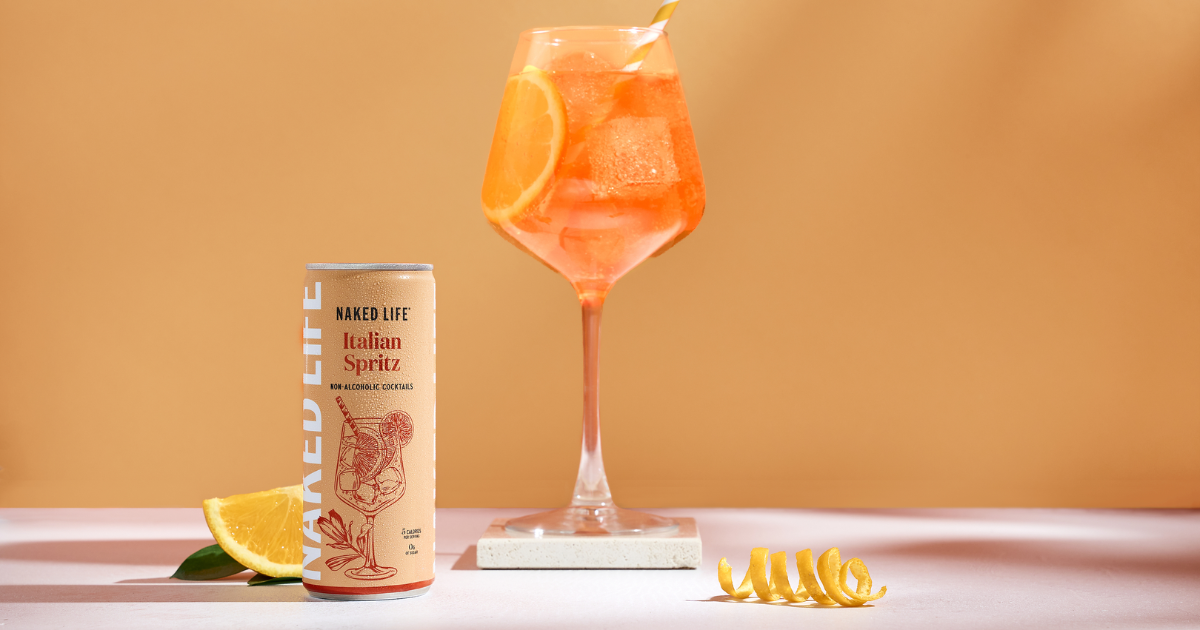
Molson Coors recently put Naked Life’s Italian Spritz on U.S. shelves at $9.99 a 4-pack—$2.50 a can—via 100 Total Wine & More locations. It’s priced closer to soda than to the premium aperitivo set (Figlia, Ghia, Lapo’s, etc.). Those independents sit at roughly 2X the per-serve price. The response from non-alc founders and beverage veterans revealed a split on what this pricing means. One camp views it as a floor reset that threatens margins. The other views it as ordinary segmentation arriving right on time.
The floor-reset camp: the risk is retailers, not consumers
As Gary Schneidkraut, former distributor turned advisor, explained: “Molson Coors can lower route-to-market costs in ways independent brands can’t. My concern isn’t consumers. It’s retailers resetting their expectations for what an NA cocktail should cost.” Even well-capitalized independents can’t match Naked Life’s $2.50 can by cutting margin. If a national chain’s buyers start benchmarking the whole set against these economics, independents get left behind.
Jill Sites, a 20-year beverage veteran, put it directly: “I don’t think the race to the bottom helps anyone, especially at a giant chain.” Chris Boyd, founder and CEO at Monday, echoed Sites’ sentiment: “Race to the bottom in such a new category = bad news.”
HOPR founder and CEO Jose Ramirez is waiting on the retail data: “My bet is that $2.50 expands trial, but repeat purchase—not initial sell-through—will show whether it resets the category.” Trial at this price is nearly frictionless; loyalty at this price still has to be earned in liquid.
The segmentation camp: this is what maturity looks like
Andrea Wightwick, CEO of Hapsy NA Cocktails, ran a segmentation analysis of the non-alc RTD space and found four natural price segments: “It’s just like any other category, let’s say orange juice. There will always be Sunny D, Minute Maid, Simply OJ, and then Natalie’s Orchid. Same with non-alcoholic.” A $2.50 can just fills a tier that was relatively empty.
Courtney O’Brien, who spent years at Coca-Cola, Danone, and Gallo, offered the historical precedent: she recalls Coke disbanding its Dasani brand team once water commoditized—yet Evian and San [Pellegrino] survived. “In every category, there’s going to be a player racing to the bottom… You have to choose where on the game board you want to play, for who you exist, and relentlessly build that.”
Beverage brand builder David Stein emphasized that consumers who compare ingredient lists will see two different products, and the entrant’s real effect may be to “push products towards a more fitting price point” where premium positioning was never earned. Meanwhile, hospitality consultant Scot Maitland added the accessibility case: meeting consumers at a price that fits their budget expands who the category reaches at all.
Either way, the burden of proof moved
The camps largely converge on one point: premium independents must position strategically to defend their pricing. Per brand strategist Rachel Colic, “When brands market a product based solely on what it doesn’t have inside the can, it’s hard to argue it should still cost the same as a traditional RTD.” Leaning into “non-alc” alone has always been a fragile basis for a premium, as we’ve previously discussed with Seedlip founder Ben Branson. A $2.50 comparison point further forces the issue.
The defensible premium runs through ingredients and brand experience. Quality-led brands hold their price if the value is evident, which raises the stakes on sampling for pricier independents with a higher barrier to trial. For those brands, it’s time to evaluate: when a shopper is holding your can and a $2.50 option, can they articulate—from the ingredients and the brand—why yours belongs in a different tier?