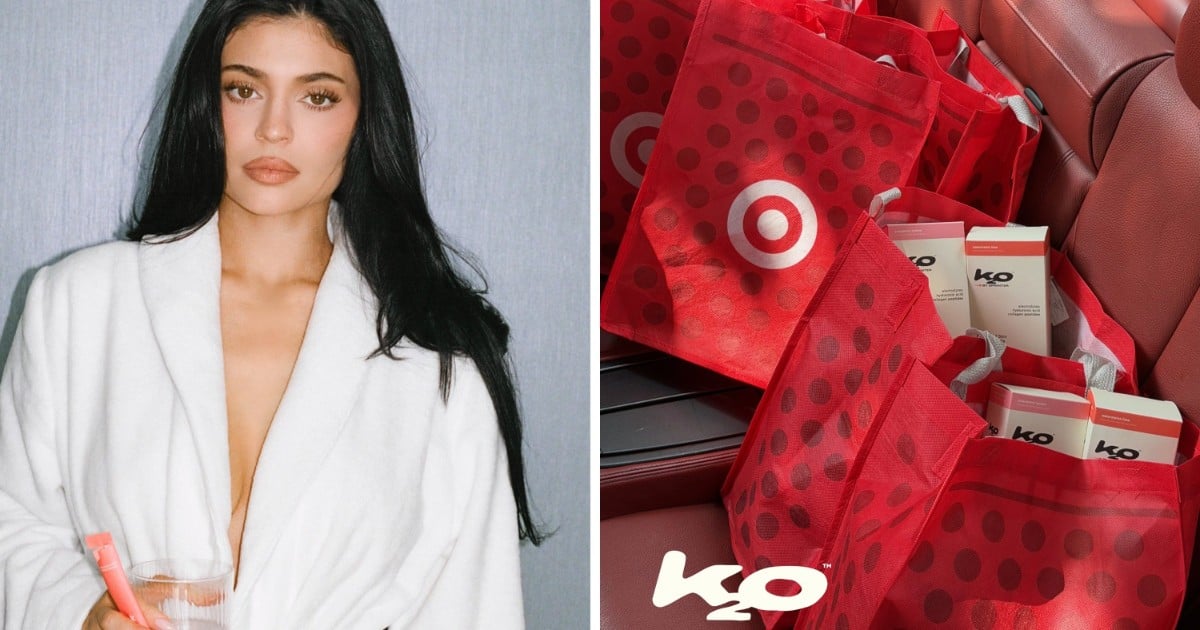
Kylie Jenner’s Sprinter launched in 2024 as a ready-to-drink vodka soda. In April, the company extended the brand into functional wellness territory with k2o, an electrolyte-and-collagen hydration mix sold DTC and on TikTok Shop. k2o just entered most Target stores nationwide, the brand’s first brick-and-mortar retail placement. The company reports $4.3 million in sales before that first store opened.
The move is a different shape from the one most alcohol brands make when they approach ex-alcohol occasions. The standard play is the analogue: a 0% ABV twin of the flagship, merchandised beside it. See White Claw Zero Proof, for example. Sprinter built an adjacent product for the parts of the night the vodka soda never touched (getting ready, the next morning) and Target placed it in the hydration set near pharmacy rather than the beverage aisle. The extension is being merchandised as wellness, with the Sprinter brand connection tying it back to the occasion.
Jay Hunter became CEO of Sprinter with the k2o launch, after serving as chief revenue officer at the supplement brand MaryRuth’s. In this interview, Hunter explains the portfolio logic behind extending rather than launching standalone, what digital performance had to prove before the Target pitch, and why he thinks the alcohol-to-non-alc extension only works when the brand has a real reason to be there.
Dry Atlas: Sprinter built its name as a vodka soda. Walk us through the portfolio logic of extending the brand into functional wellness territory rather than launching k2o as a standalone.
Jay Hunter: It felt like a natural extension of what we were already building with Sprinter. Sprinter owns the social occasion, and k2o gave us a way to expand that relationship with the consumer beyond the drink in their hand that night. Beauty is also a huge part of Kylie’s world, so hydration plus beauty felt like a space where we had a real reason to play. We weren’t interested in launching another hydration powder just to launch one. The opportunity was to take something people already do every day, hydration, and make it more relevant to beauty and the lifestyle around the Sprinter consumer.
DA: You’ve described Sprinter as owning the party, before the party, and the next morning. How does that occasion framing shape what you build?
JH: We think a lot about the entire occasion rather than one specific moment. There’s getting ready, going out, the actual event, and then the next morning. Sprinter fits naturally into one part of that, and k2o gives us permission to show up in a lot more of it. That creates a much bigger canvas for the brand. k2o can be part of getting ready and wanting to look your best, staying hydrated throughout the day, or resetting the next morning. We want the products we build to fit into those routines rather than trying to manufacture an occasion for them.
DA: k2o launched on DTC and TikTok Shop and hit $4.3 million in sales before entering retail. What did that digital performance prove that made Target the right first retail partner, and what carried the pitch?
JH: The biggest thing digital proved was that there was real demand for the product beyond Kylie’s initial reach. We did $4.3 million before entering a single retail store, and TikTok Shop became a strong acquisition channel for us. We had creators talking about the product, consumers buying it, and most importantly, people coming back. That gave us a lot of confidence going into retail because we weren’t pitching Target on an idea. We had already proven that the product could sell.
Target was always very high on our list for a first retail partner. Their consumer overlaps well with ours, they understand beauty and wellness, and they give us the ability to take something that was working extremely well online and put it in front of millions of new consumers. What carried the pitch was ultimately pretty simple: strong brand, strong product, strong digital performance, and a consumer that already wanted it.
DA: Where does k2o sit in the Target store, and how deliberate was that placement decision?
JH: We’re in the hydration set near pharmacy, including some strong endcap visibility. Target ultimately controls merchandising within their stores, but we worked closely with their team throughout the launch. For us, being merchandised alongside hydration was important. We want consumers to understand immediately what the product does, while the branding, beauty benefits, and Kylie association give us a way to stand out within that set.
DA: Celebrity-founded brands reliably drive trial. Then there’s the question of repeat purchase once the novelty cycle ends. How are you building velocity that outlasts the launch moment?
JH: Kylie is an incredible advantage when it comes to awareness, but celebrity can only get someone to try a product. It can’t make them buy it again. That’s why we’ve been so focused on the actual product. It has to taste great, the benefits have to make sense, and it has to become something people want as part of their routine. We’re seeing that happen, which is probably the part of the business I’m most excited about.
From there, our job is to keep giving that customer reasons to stay engaged. That means new flavors, collaborations like HydroJug, new formats, and eventually expanding the platform into other areas where hydration and beauty intersect. The goal isn’t to build a celebrity product. It’s to build a really big brand that happens to have one of the most influential people in the world behind it.
DA: Alcohol consumption trends are pushing more alcohol brands to look at the non-alc side of the occasion. Do you see the Sprinter move, an alcohol brand extending into functional wellness, becoming a playbook for the industry?
JH: Potentially, but I think it only works when the extension actually makes sense for the brand. Consumers aren’t thinking about categories as rigidly as companies sometimes do. They’re thinking about their lifestyle. They might drink alcohol one night, drink less the next, care about hydration, care about beauty, work out, travel, and still want brands that feel relevant to them across all of those moments. For us, Sprinter and k2o can live together because they serve the same consumer and different parts of the same lifestyle. I think you’ll probably see more brands try to expand that way, but consumers are smart. There has to be a real reason for the brand to be there.