Big Alcohol is no longer just dabbling in non-alc. It’s investing, scaling, and positioning itself for long-term relevance. With traditional alcohol sales stagnating and Gen Z drinking less than any previous generation, the largest beverage companies in the world are betting big on alcohol alternatives.
What started as a fringe experiment has become a core strategic focus. Non-alcoholic versions of beer, spirits, and even hard seltzers are no longer niche offerings—they’re being treated as future growth engines. And the pace is accelerating: new product launches, global marketing campaigns, and major infrastructure investments all point to a sector undergoing rapid transformation.
But while some applaud Big Alcohol’s involvement for normalizing non-alc and expanding access, others remain skeptical, raising concerns about quality, authenticity, and intent. Are these companies truly committed to the space, or simply chasing the hype? Let’s take a look at how Big Alcohol’s non-alc strategy is evolving, and what it signals for the future of the category.
Beer
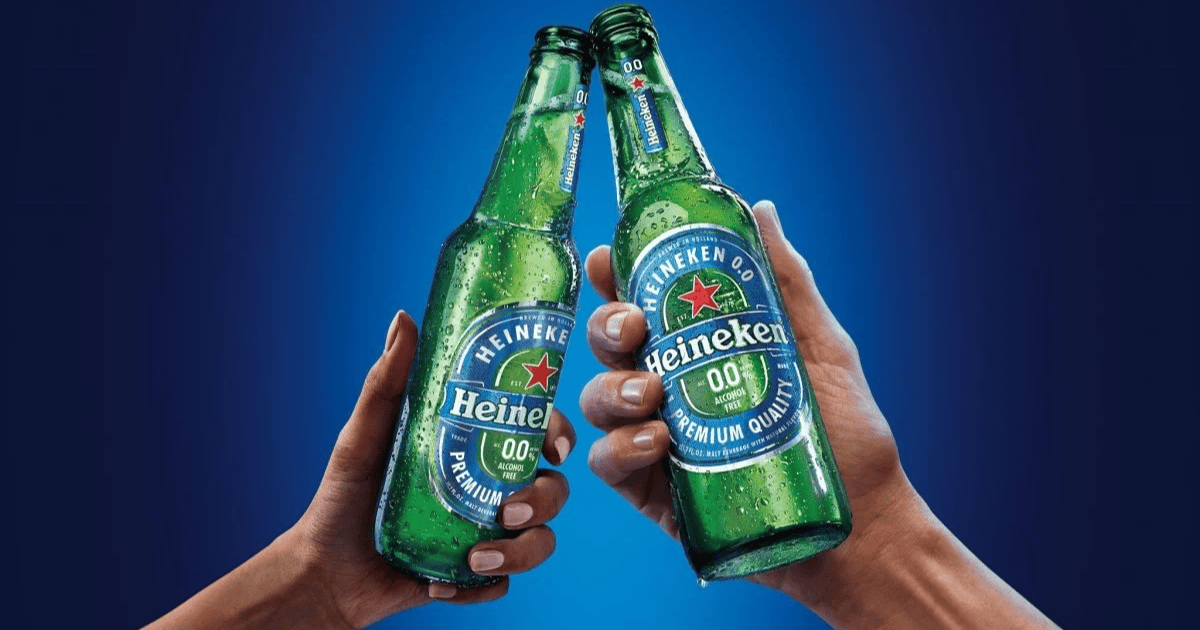
This phenomenon is most apparent in the beer category. Heineken 0.0, introduced in 2017, accounted for 7% of Heineken brand sales in 2023, per Food Dive, and is available in over 110 markets globally. Guinness 0.0 wasn’t far behind: it launched in late 2020, was recalled within weeks, and relaunched in 2021. Diageo has forecast it will reach 10% of Guinness sales in Ireland.
More recently, Molson Coors has ramped up its non-alc efforts with offerings like Blue Moon Non-Alcoholic (launched in late 2023), Peroni 0.0 (which it imports in the U.S.), and Coors Edge. “Beer will always be at the heart of what we do, but we know there’s an enormous opportunity with non-alc and that’s why we’ve committed to making it an important part of our business,” said Kevin Nitz, the company’s Vice President of Non-Alcohol Products, in 2023. Late-2023 launches in the beer space included Kingfisher’s Kingfisher Zero and Paulaner’s Weizen Radler 0.0%.
At the start of 2025, Heineken reaffirmed its commitment to the space with new research and growth numbers. According to their latest data, the global non-alc beer market is now worth $13.7 billion and accounts for 1.7% of beer volume. Heineken 0.0 grew 14% in the first half of 2024, and low- and no-alcohol beer now accounts for over 4% of Heineken’s portfolio. The company says 0.0 beer has grown at a 10% CAGR over the past five years and believes this is still just the beginning.
Spirits
In the spirits domain, Damrak Virgin and Tanqueray 0.0 launched in 2020 and 2021, respectively. In 2023 and 2024, Diageo and Pernod Ricard introduced Captain Morgan 0.0% and Beefeater Gin 0.0% to the European market. Diageo spent two years on its formulation, while Pernod Ricard established a state-of-the-art production line to serve as a one-stop shop for non-alc spirits production and R&D.
Diageo and Pernod Ricard have also made significant investments in the non-alc space in recent years, including Ceder’s, Ritual Zero Proof, and Seedlip. In September 2024, Diageo fully acquired Ritual Zero Proof after it had invested via Distill Ventures in 2020.
Meanwhile, Moët Hennessy made its first-ever move into the non-alc space by acquiring a minority stake in French Bloom, the premium non-alc wine brand. It’s a notable development from LVMH, the luxury powerhouse behind Moët & Chandon, Louis Vuitton, and Dior.
Serious investment
Big Alc is backing their non-alc brands with serious dollars. In 2023, Diageo committed €25 million (about $27 million) to increase Guinness 0.0 production by almost 300%, and followed with a further €30 million in 2024. They’re also going big on marketing, from high profile sports sponsorships to large-scale giveaways (they gave away 50,000 free pints one St. Patrick’s Day alone).
Heineken just might be edging them out on marketing spend, though. The company has said it puts a quarter of its Heineken brand marketing money behind Heineken 0.0, leaning into confidence messaging to counter social stigma. We’re also seeing slick, expensively-produced campaigns, like Diageo’s 2023 “Why You Always Whying?” spot for Captain Morgan 0.0%.
Molson Coors has slightly refocused its strategy. In 2023, the company sold its 57.5% stake in cannabis beverage venture Truss Beverage Co to Tilray. The move marked an exit from cannabis drinks.
Why now?
The sharp decline in alcohol consumption among Gen Z—now entering legal drinking age and gaining spending power—is a major driver. IWSR data shows that 63% of Gen Z in Japan haven’t had alcohol in the past six months, followed by 54% in the US and 44% in Canada, per its 2023 tracking, though IWSR’s 2025 survey shows Gen Z participation rebounding.
Large alcohol companies may also be responding to investor pressure. As alcohol market growth stalls and public concern about alcohol’s harms grows, non-alc offers a strategic hedge. Diageo, for instance, has made moderation central to its investor messaging through its “Society 2030” ESG plan.
There’s also a tactical benefit: launching non-alc brands tied to existing alcohol brands creates a workaround for tightening advertising regulations—especially in sports. European regulators are increasingly limiting alcohol ads to protect underage audiences, but non-alc variants still qualify as sponsors. Brands like Guinness and Heineken have leaned into this, sponsoring soccer, rugby, and Formula 1. AB InBev’s Corona Cero in 2024 became the first global beer sponsor of the Olympics. Still, the use of names closely associated with alcoholic products continues to raise regulatory and ethical questions.
What do consumers think?
A Dry Atlas reader survey revealed some concerns about Big Alcohol’s motivations, with 11% saying their involvement in non-alc is a bad thing. That said, the majority (61%) view it positively, appreciating the normalization of non-alc options. “More options is always better!” was a common sentiment. In the middle of the pack were those who raised concerns about the taste of these new products, assuming that they were fast-to-market cash grabs.
Big Alcohol’s success in non-alc will depend on addressing those consumer concerns, particularly about product quality and perceived authenticity. If these companies can meet rising expectations while tapping into broader trends like ABV optionality and flex drinking, they stand to benefit from a category that increasingly blends alcoholic and non-alcoholic choices.
The bigger question is whether this move reflects a genuine long-term strategy or a short-term response to shifting market pressures—one that will ultimately shape both industry dynamics and future company performance.