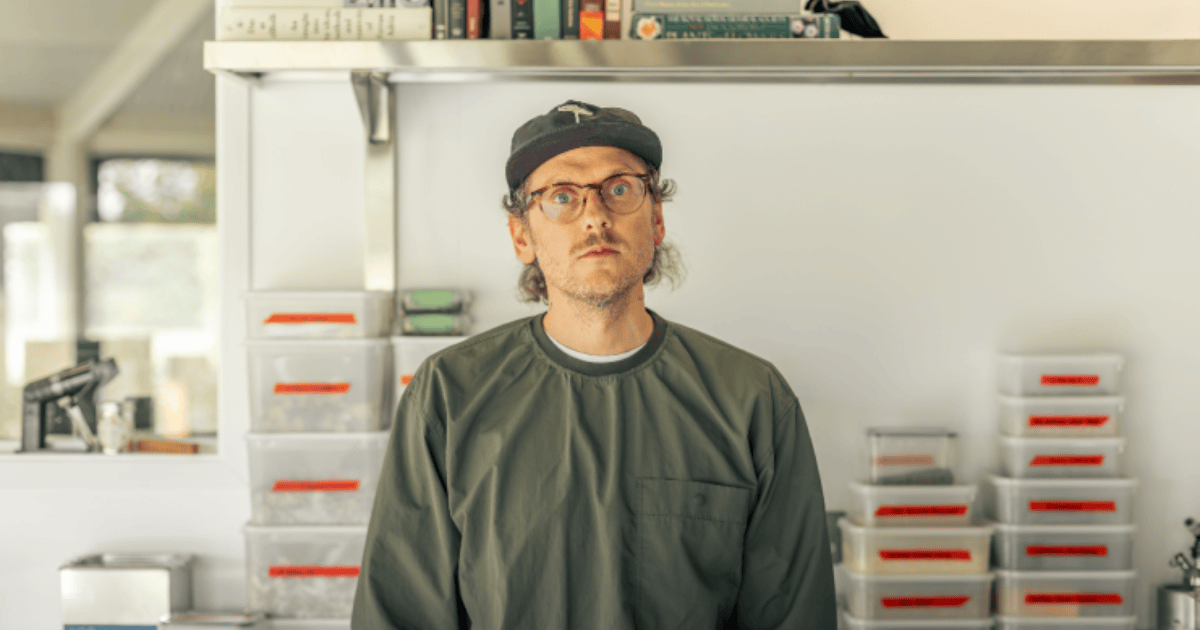
In his lab outside of London, we sat down with Ben Branson, the founder of Seedlip, Seasn, and now Sylva, a novel non-alcoholic spirit brand that’s reimagining dark spirits <0.5% ABV. In this interview, Branson shares his insights on why the future of non-alc lies in innovation, not imitation, and explains Sylva’s unique focus on sippable products to be enjoyed neat. From exploring untapped wood flavors to championing hyper-local production models, Ben offers a fresh perspective on building a brand that reflects where the future of drinking is headed.
Dry Atlas: Sylva is what we call a novel non-alc spirit. You’ve spoken before about the challenges of competing with traditional spirits. Do you see far more value in creating entirely new beverages rather than imitating what’s been around for centuries?
Ben Branson: Absolutely. Let the big alcohol brands do their thing—that’s their lane, and they’re bound by their trademarks and legacy expectations. Gordon’s, for example, is always going to taste like Gordon’s because they’re constrained by what their brand represents. But new brands like ours don’t have that baggage. We have the freedom to innovate, and that’s where the real value lies. Why replicate something that’s already been perfected?
I recently wrote a column on this for Drinks International, warning against launching imitation products. It’s a risky path. The alcohol space is crowded, and the last thing consumers want is another knockoff gin. Instead, we should focus on creating new experiences that resonate with modern drinkers. The way we consume beverages is evolving, and non-alcoholic options are part of a broader cultural shift toward moderation. Alcohol consumption isn’t suddenly going to spike again; those days are behind us. The non-alc category has a long runway ahead, and I’m excited to see where innovation takes us.
DA: That makes sense, as many spirit alternatives that mimic the “real deal” still struggle to fit into traditional drinking occasions. Perhaps more mixology education is required, even if something is meant to be a 1:1 replacement in cocktails. Was your focus on neat sipping intentional from the start?
BB: Absolutely. Ready-to-sip drinks are key for us. Even with Seedlip, we noticed a learning curve: consumers needed to add ice, tonic, garnishes—it was a lot of steps. With Sylva, we’re stripping all that back. All you need is a nice glass. No mixers, no extra fuss. It’s about simplicity and accessibility.
This approach also fills a unique gap in the market. Many consumers are looking for something sophisticated yet simple—a drink they can pour and enjoy without any preparation. That’s what we’re offering. It’s about simplicity and creating a moment of reflection and connection with the drink itself.
DA: Sylva is derived from wood and currently produced here outside of London. I was so pleased to learn that you’re also going to be bringing Sylva production to New York.
BB: Oh my God, yes—we’re heading to upstate New York, in a spot surrounded by trees. The industry has somewhat forgotten about bringing the producer close to the produce. We see that connection in winemaking, but it’s almost absent in spirits production. It feels like rediscovering a lost art, this idea that where your ingredients grow should influence your final product. It’s exciting to think about what this proximity will do for the flavors we’re able to create.
New York is prime farm country, with agriculture as the state’s second-largest industry. Yet, few are exploring this in the beverage world. Years ago, I noticed a handful of companies there experimenting with accelerated maturation processes for alcohol, like bourbon, using ultrasound or sonic maturation to mimic traditional aging. But no one was exploring what could be done with non-alcoholic spirits. We’re not trying to replicate bourbon or gin—our goal is to see what’s possible extracting flavor from wood. And let me tell you, the potential is immense. Wood holds a world of untapped flavor that could redefine how we think about drinks, food, and even culinary experiences as a whole. There’s so much about trees we haven’t explored. I can’t wait to dive in.
DA: So, it’s a horizontal production model you’re pursuing?
BB: Yes, exactly. I’m excited about this model—it’s such a departure from the way most large-scale beverage companies operate. We’re taking a hyper-local approach: producing in the UK for the UK, in the US for the US, and eventually in Japan for that market. Each location will essentially be its own test kitchen, giving us the flexibility to create unique products that reflect the regional agriculture and environment.
The larger and more industrialized your production process, the more compromises you’re forced to make. Those compromises inevitably impact the quality of the liquid. By producing horizontally, we’re not only cutting down on the need to ship raw materials and finished products across the globe, but we’re also able to work with native species and truly capture the essence of each place. For American consumers, it’s much more meaningful to experience flavors tied to their own agricultural heritage rather than learning about UK-grown wood. This approach allows for deep regionalization.
DA: You’re clearly passionate about wood! Have you considered working with universities to explore it further?
BB: Funny you ask—we’ve already started conversations with a UK university that specializes in brewing and distilling. I genuinely believe there’s a PhD project waiting to happen here: fully documenting and understanding wood flavors. There’s no historical manual for distilling or extracting flavors from wood, unlike what we have for spirits or culinary techniques. We’re piecing together knowledge from barbecue culture, fragrance industries, and dark spirits, but there’s so much left to uncover.
It’s fascinating when you think about it. We know so much about trees from an environmental and medicinal perspective, but almost nothing about their culinary potential. I’d love to dedicate myself to that kind of research one day, but for now, we’re channeling that passion into creating commercial products. It’s a blend of scientific discovery and creative exploration, and I’m excited to be at the forefront of it.
DA: The average consumer might not understand the depth and complexity behind Sylva. Do you plan to educate them, or do you hope your products will speak for themselves?
BB: There are two sides to this. First, we see a real gap in the market for neat, sippable non-alcoholic drinks. Most non-alc products are designed for cocktails, but we’re creating something for those slower, more reflective moments—an experience of sipping neat that highlights the natural flavors of wood. It’s a ritual we’ve barely scratched the surface of, and it’s where I think the magic happens.
The second aspect is about rethinking how people view trees. Most don’t realize how packed with flavor they are. For instance, we’re working with black locust wood, which has incredible characteristics that we’re just beginning to explore. Our goal is to share these discoveries and invite people to slow down and appreciate what nature has to offer. It’s a sip-and-see approach: try it, experience it, and let it reshape how you think about drinks and their ingredients.
DA: What advice would you give to other non-alc founders who are struggling to educate consumers about their products?
BB: Remember, people are busy. They’re not going to spend time educating themselves on your product—you have to meet them where they are. Most consumers drink both alcohol and non-alcoholic options. They’re not making a full switch. Your job is to make it as easy as possible for them to choose your product in any given moment.
Don’t overcomplicate things. You’re not just selling a product. You’re selling an experience. Focus on how your product fits into their lives and enhances their routines. Ultimately, success comes from understanding your consumer and delivering something that easily resonates with their needs and desires.
DA: How do you think consumer understanding has evolved since your early Seedlip days? That idea of what a “mocktail” is, for example, has changed a lot.
BB: I don’t even get annoyed about the word “mocktail” anymore. I’m just like, “Okay, fine, let’s roll with it.” But let’s also be clear: a mocktail is not the same as a crafted non-alcoholic beverage. They’re different categories, and that’s fine. What really gets to me, though, is the term “non-drinker.” That phrase simply doesn’t make sense. Who walks around calling themselves a non-smoker or a non-pork eater? We don’t define people by what they don’t consume. Every single species on the planet drinks something every day to stay alive. The idea of a “non-drinker” is a strange concept that frames drinking as exclusively tied to alcohol.
And when I tell people I’m in the beverage industry, they automatically assume I’m talking about beer or spirits. It’s funny, but also reflective of how entrenched alcohol is in the language of drinking. That’s where I think we need to shift the dialogue. Instead of asking, “Are you drinking tonight?” it should be, “What are you drinking tonight?” It shouldn’t be about whether someone is drinking alcohol. It should be about what they’re choosing to drink. That subtle reframing helps normalize the idea that drinking doesn’t have to mean alcohol. It can mean anything that suits your moment or mood.
DA: That’s a great point. You wouldn’t ask a vegetarian, “Are you not eating tonight?”
BB: Exactly. It’s such a weird and unnecessary framing. You wouldn’t ask someone who drives an electric car, “Are you driving?” The presumption should simply be, what kind of car, what kind of food, or in this case, what kind of drink?
I think Heineken has the right idea here. Their vision, at least in the US, is that you’ll order a Heineken and then be asked, “With alcohol or without?” That approach feels seamless, especially for beer. It gives consumers the power of choice without forcing them to identify as “drinking” or “not drinking.” It’s a clever bit of psychology, too—you feel like you’ve made a decision, but you’re still buying Heineken. That’s where the industry could head, providing options without the unnecessary labeling or assumptions about alcohol.
DA: I hope it does. Now, back to Sylva. It’s clear you’ve been highly intentional with product development. Can you elaborate on how your idea generation and execution work?
BB: I’ve always believed that if something takes too long, there’s probably something wrong with its application. For instance, I’m not going to spend three years trying to perfect Paduk. Either it works, or it doesn’t—and that’s largely due to all the groundwork we’ve already done.
Getting to the heart of what matters takes time, and I can’t shortcut that process. I didn’t think, “Let’s make a neat sipping liquid with cool wood” on day one. That would’ve been a quick but shallow conclusion. Now, looking back, it seems so simple—just neat liquids and unique wood. That’s the foundation. From there, the process becomes simpler, and your subconscious starts guiding you. When you find that sweet spot, it just clicks. I’m always amazed when people proudly say, “This took 200 iterations.” To me, that’s not a badge of honor. We’re only on iteration 14 with Paduk, and that feels right.
I’m still fascinated by how people start businesses and develop products. There’s no one-size-fits-all formula, and everyone works differently. That’s especially true when you consider neurodivergence—some people thrive with structure, others with flexibility. The idea that there’s a single, correct way to launch a business is laughable.
Take the advice to interview 200 customers, for example. What would you even ask? “Do you want to pay £40 for wood juice?” Of course not. I never approached things that way. I just trusted my instincts and gave people what they didn’t even realize they wanted. That’s how I’ve always worked—avoiding rigid demographics or narrow categories. There’s so much more to focus on than fitting neatly into predefined boxes.
This interview has been edited for length and clarity.