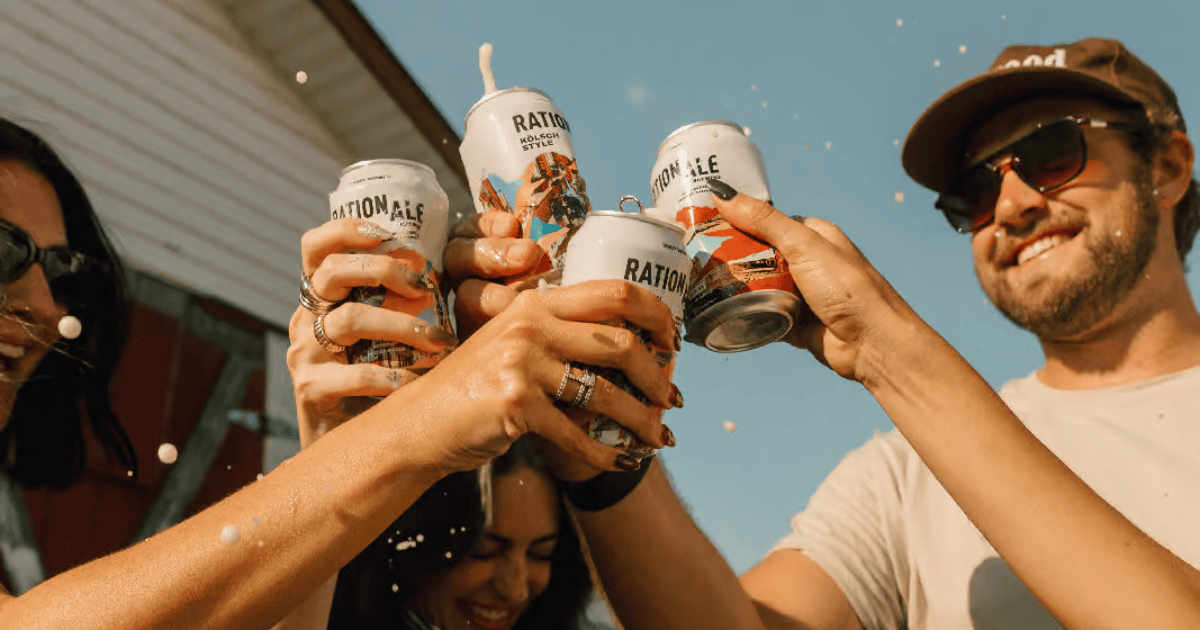
Presented by RationAle Brewing
When Jamie Fay and Wendy Pickett co-founded RationAle Brewing, crafting non-alcoholic beer that actually tasted good wasn’t the only focus. They were also aiming to change the conversation around drinking altogether. With decades of experience in consumer goods and deeply personal stories tied to alcohol, the duo set out to build a brand that invites everyone to rethink their relationship with alcohol, without judgment.
In this interview, Jamie and Wendy share the origin story of RationAle, the role that mental health plays in their mission, and why they’re building a brand that’s about helping people feel better, live better, and connect more deeply.
Dry Atlas: What inspired you to start RationAle, and how did your personal experiences shape the brand?
Jamie Fay: It all began with a passion for drinking high-quality beer. Wendy and I both love it. We’re not sober. We’re not preaching abstinence. But I’ve had a deeply personal relationship with alcohol in my family. My dad was the youngest Supreme Court judge in Ontario, a successful professor, and a trial lawyer. But alcohol took all of that away. He lost everything: his legal career, his teaching role, his health.
When I spoke at his funeral in 2015, I found myself giving this manifesto, talking about how important it is to make better, more rational choices around alcohol. Fast forward to 2021, and my sons and I are sitting around a campfire. I’m reminding them to be thoughtful about what, when, and with whom they drink. I kept using the word “rational.”
My younger son, being smart, said, “Why don’t you just start a beer company called RationAle?” We laughed. He then went upstairs, grabbed my credit card, and registered the name online. Next morning, the confirmation email was waiting by the coffee maker.
Wendy Pickett: Jamie called me and said, “I think this is what my life has led up to.” Given our backgrounds—Jamie’s in big CPG, mine in more founder-led, acquisition-heavy businesses—it just clicked. We knew how to build brands. But this had a different energy. There was a personal mission attached to it.
DA: Even with your combined experience, were there challenges early on in bringing RationAle to life?
WP: Definitely. The first question we had to answer was: is there really a market for this? We dug into the data and validated that this wasn’t a trend, it was a shift. In Europe, non-alcoholic beer makes up about 15% of the beer market. In the US, it’s still much smaller, but the trajectory is there.
Then came the product itself. It wasn’t just about removing alcohol. The beer had to be something we actually wanted to drink. Finding the right brewer to execute that vision, one who could dealcoholize beer safely and retain a craft flavor profile, took time. But it was crucial. We weren’t willing to compromise on quality.
DA: RationAle doesn’t feel like other non-alcoholic brands. It’s edgier. Was that intentional?
JF: Absolutely. Many brands in this space go hard on the wellness positioning, with visuals like yoga mats, mountaintops, and marathons. That’s great, but it doesn’t speak to everyone. We wanted RationAle to resonate with people who still drink. People like us. We drink alcohol and we enjoy it. But we also recognize that not every occasion needs it. That’s the voice we brought to the brand.
We wanted to invite more people into the category, not just the ones already living a sober lifestyle. That meant positioning RationAle as a choice for the mindful drinker, not just the abstinent one.
DA: This brings us to your campaign about mental health. Why tackle that subject so head-on when others tend to steer clear?
JF: Because it’s a real reason people are reassessing alcohol. Not just physical wellness, but how drinking makes them feel. And often, that’s tied to mental health. There’s a crisis going on. We don’t want to show people aspirational images of someone jogging with a non-alc beer, we want to talk about what’s behind those lifestyle changes. And that means being honest about mental health.
We’ve had those moments, those Sunday mornings where we wish we’d stopped at two drinks or had a RationAle instead. We’re not above it. We’re living it too.
WP: That’s why we launched our “Crush the Crisis” campaign. This month, which is Mental Health Awareness Month, we’re partnering with BetterHelp to offer one free month of online therapy. Anyone attending our sampling events at places like Whole Foods or Total Wine can scan a QR code to access it.
Plus, 1% of our sales now go to mental health initiatives—both nationally and locally—starting with H3-7P! in San Diego. They organize music therapy, breathwork, and community-based support.
DA: It sounds like this is more than a campaign. Is mental health now part of the RationAle brand DNA?
JF: It is. We’ve rethought our entire brand presence around it: visual identity, messaging, everything. And it’s authentic, because we’re not speaking from the outside in. We live this. We drink. We moderate. We’ve made mistakes. We’re not preaching. We’re opening up space for others to explore what makes sense for them.
WP: And the response has been incredible. When we do demos or events and share our story, people open up right there at the booth. They talk about their families, their own relationship with alcohol. It’s not a sales pitch, it’s a conversation. That’s what keeps us going.
DA: As you look ahead, what’s next for RationAle? How do you scale without losing that human connection?
JF: It’s tempting to go wide, push into 45 states, raise a ton of capital, chase market share. But we’ve chosen to go deep first. We’re in eight states and on Amazon, but every market we enter, we want to show up with full presence. Retail support. Community activation. Sampling. Education.
Five years from now, we want to be the brand on stage talking about how mental health and mindful drinking evolved together, and how we helped lead that change. That’s our vision.
WP: And through it all, we’ll keep making damn good beer. We won’t cut corners. We’re not chasing trends. RationAle will always be about quality first.
This interview has been edited for length and clarity.