Kin Euphorics founder Jen Batchelor grew up in Saudi Arabia, where her dad’s moonshine-fueled house parties showed her how drink can bring people together. But, as she came to see alcohol itself as a disconnective force, she set out to redefine the drinking ritual. With Kin, she’s created a functional beverage brand that empowers people to deepen their connection to others and self—without the downsides of booze. In this Q+A, Jen discusses the challenges and triumphs of introducing a novel concept in the beverage industry, her commitment to Kin’s mission, and her broader goals for human flourishing.
As a child, you actually had a front row seat to the positives of alcohol bringing people together, with your dad brewing beer and moonshine to host house parties as expats in Saudi Arabia. I’m curious: what observations brought you to the point of “I want to recreate that experience, but specifically without booze”?
It was a confluence of things. You know, booze is very much a connective, sort of ritualistic, conduit to community building and family building and friendship in Saudi. We didn’t really have that when I came back to the States. I really thought of it more as a disconnective: disconnecting from our body, disconnecting from community, from our desires, from our highest self.
So, recognizing that in my late-20s and starting to explore my own health journey, my own spiritual journey, I realized that people still crave that connectivity and that drink is actually a really great way to do that. There is something great about the ritual itself. It’s just the content, right, the actual liquid, that could be elevated.
It was just a whimsical idea. It was something that I was trying on for a size in my own life, crafting extracts and different elixirs in my home kitchen in the Lower East Side, New York. I was having a lot of fun with it. People were really responding to it. I started to be immersed in the worlds of microdosing, and nootropics, and all these ways that people were trying to level up or connect deeper, either with self or others. And I thought, “wow, there’s this really interesting thing, even if it’s just the initial rumblings of it, people are moving towards it. So let’s dig deeper.”
A lot of the initial Kin formulations were very much fringe and probably wouldn’t be able to sit on shelves today. I would say that the products, the end game, the products that you’ve gotten to experience off the shelf, still very much hold the spirit of it. Playing with adaptogenic botanicals and other things that can move the spirit in that way.
With your focus on functional ingredients and this “euphorics” category you’ve really created, are you going to stay laser-focused on these age-old functional ingredients? Or are you also curious about the future of food technology, scientists who are trying to almost reformulate ethanol to remove the downsides, for example?
I think we’ll always embrace it. Dr. [David] Nutt, somebody who has effectively done that in the UK, was very, very early in Kin days. We had many conversations with him, and he was very aware of what we were building. It’s always been a fascination of ours.
Today, we work with some of the top nutraceutical firms in the country that are leveraging some of these biotechnologies already, many of whom started in pharma. This firm, who we still work with, said, “yeah, you can’t get those functionals in a 60 milliliter container. Good luck.” But they rose to the challenge. It took them one year and they got there. We created something that never existed before, from that perspective. We’re really proud of that. We’ll continue looking at the new technologies as they continue to arise.
And there are different things we’ve never touched that are still interesting to me, whether we have to do them in small batches. Slow and precise fermentation being one of them, different forms of extraction—there’s so much more to play with. Right now, the focus of the game is scaling and it’s hard to think of these things these days, but they’re not off the table. I definitely still want to keep exploring what’s available. It’s really fun.
It sounds like you’re really driven by the craft and probably a bigger goal around human flourishing. You talk a lot about consciousness and the energy we bring to the world. Outside of your business goals of scaling, what’s your most ambitious goal for the impact that Kin—or you as an entrepreneur—can bring to the world?
I reflect so much on the last few years of Kin, and we’ve turned so many people onto this idea that you can affect mood, you can create something that has no mirror.
So much of this non-alcoholic space is about creating these analogs, these one-for-one, non-alcoholic whiskeys, for example. For us, it was like: “no, I want to create iconic flavors. I want to create something that never existed before.” Test and push the palates of our core demo and of the world at large. Turn them onto something that actually impacts their state. Our flavors are not intended to be anything other than truly efficacious, truly functional.
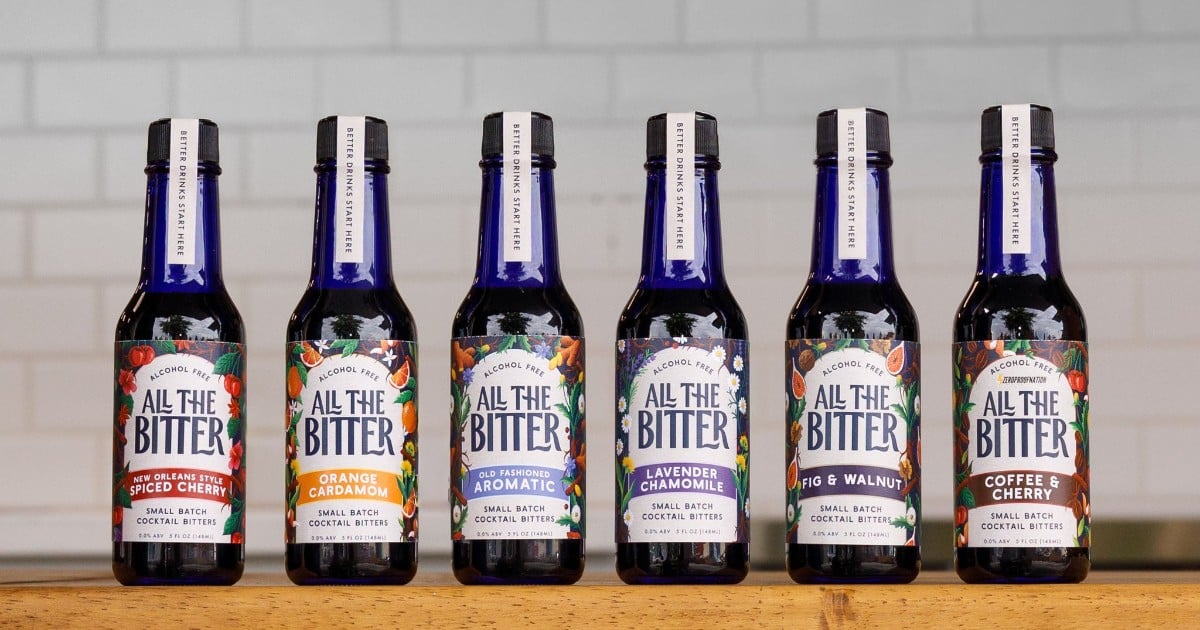
Like the bitters, from an ayurvedic perspective, bitter notes can soften addiction to sweetness. In the emotional sense, too, right? Like, if you’re stuck in love, they say to have bitter herbs. It’ll wake you out of your stupor. If you’re stuck in the mud, have spice. There’s so much about that that fascinates me. Leveraging flavor, leveraging technology, ingredients to help really move the mind. Keep it fluid, keep it flexible, keep it sharp so that we can change the way we feel by changing our perspective of the world and what’s possible.
That was always a goal with Kin. It’s lofty, it’s heady. It doesn’t always land, but that’s OK with me. For the people that it does land for, it’s a game changer. So we’ve kind of already done it from that perspective. That’s one of the only reasons for me to scale is to keep writing that message and keep turning people onto something new.
As a trailblazer in the functional space—inventing the concept of “euphorics,” building a brand that’s not in reference to alcohol—I imagine early on it must have been hard to get people to see your vision. Obviously you successfully raised funding, you’re successfully scaling the brand. But, early days, whether it was from your friends or from investors, how did you handle skepticism? Were there people who just didn’t get this lofty goal of yours and how you were going to achieve it with Kin?
We went straight to the dreamers. If you look back at our history, our first money in was from a VC that invests only in the future technology, the food and drink that will change the fate of the world in the next 50 years. They really believed that a change was coming and that there needed to be bold ideas to make that change possible. Still to this day, they’re future of drink investors.
When you go to people like that, that share your core values, your belief system, your optimism that the world is going to be ready for this in our lifetime—those are the ones worth pursuing. That’s how you get the right partners on deck.
Today, there’s a lot of bad actors in the VC world. There’s a lot of folks that are incredibly opportunistic that don’t really get why we’re doing what we’re doing. So, that’s been challenging. For us, it’s just being really staunch. For as much investment as we’ve brought in, we’ve rejected just as much. We’ve left just as much on the table and said “no” to certain folks who were clearly not on the mission. That’s a hard pill to swallow. But, there are visionaries. You just have to look and you have to align with folks that are as big and bold as you are.
I had no idea how hard it was going to be to bring this to the world. I wonder that about myself. If I knew how hard it was going to be, to not only launch it but to sustain it, if I would have done it. But I’m glad that I did.
You’ve hit so many amazing milestones. You’ve brought in Bella Hadid, you’re scaling, everything seems to be on the ups. As you look ahead, is Kin your life’s mission? Or, do you see Kin as a vessel for this broader goal of supporting human flourishing, raising consciousness? Perhaps you see yourself in 10 years doing something outside of beverage?
It’s such a great question. I’ve done a lot of reflection on this very topic recently, because we just had our fifth commercial year celebration. The first time we turned our website on was December 5th, 2018. I’m at the halfway point of a decade, what now?
If there’s a lesson here for other founders, or folks that consider themselves mission-driven creators, I would say: as soon as you invite investment, as soon as you recognize that there’s a commercial interest here, that might dilute the mission.
I could do Kin the rest of my life, no problem. There are other agendas at play, though, right? In many ways, they make Kin better, because they create these boundaries that you have to be creative within, that you have to honor the mission within. That helps you to focus your effort, it helps you to get the message out in a bigger way. It’s been a continued challenge for Kin to do that—to hold the magic of what we’ve built and still bring it to the masses.
But, my biggest acknowledgement over the last year has been: at a certain point, you have to just set it free and trust that it will continue to evolve in a way that will allow folks for generations to really enjoy it. That’s going to be beyond me. Whether I stay on at Kin for the rest of my life or not, that’s the reality. I’m committed to this. I’m here to see it through. I now have two babies of my own so I don’t necessarily call Kin my baby anymore. Maybe it’s my first one.
To your point, it’s a beautiful vessel for the work that I will do for the rest of my life. It’s just something that I believe in. It continues to teach me and it helps me to refine what I love doing on a day-to-day basis. I’m grateful for that.
For our last question, more from the consumer perspective: for people who are reevaluating the role of alcohol in their lives, for people who are considering a more conscious approach to living, what would your advice be for them? How would you guide the average person to start to live a more mindful, conscious life?
Such a great question. There are so many ways into this lifestyle that you have to have grace for yourself and consider yourself an adventurer or explorer in this, right?
There are so many perspectives on this. Maybe you’re listening to Dr. Andrew Huberman and want that fact-based reasoning and logic to guide you—even if that’s your way in, being open and receptive to the opposite extreme of the spiritual aspect, and seeing if there’s a way to make this really holistic can be helpful. I find when people do that, it really sticks because you have this 360 view of how these shifts can happen and you just become more attuned and more aware.
Anyone can do it. I look at my mom’s family, we’re a bunch of wild Cuban, French people, we eat and drink everything. They’re really about the pleasures of life. There’s a sensuality to life. So, what’s the motivation for these folks? It’s taste—and it’s vanity, I’m not going to lie. It’s, “oh my God, my skin is dry. My libido is down. My this and that.” And I’m like, “well, how about you try to give up alcohol for 30 days and report back. And if you don’t notice the change, we won’t talk about it again.” But 99.9% of the time, things change. It’s about helping yourself, helping others find that hook, and then opening the door on the other side. Finding things that really make it land for life.