Amsterdammers will tell you the word “booze” has Dutch origins. While the true etymology of the word is uncertain, there’s no doubt the Netherlands has a storied and fascinating history with regards to drinking.
Perhaps better known today for its laissez faire approach to cannabis and psychedelic fungi, Amsterdam is home to Lucas Bols, which bills itself as the world’s first cocktail brand and which the Dry Atlas team visited this month. The abbreviated history: the Bols family began distilling in Amsterdam in 1575 and later, per the company, became a major shareholder in the Dutch East India Company, which gave them first choice of newly arrived herbs and spices from distant lands. Combining their knowledge of distilling with maceration and percolation of herbs and spices allowed them to create hundreds of flavors of liqueurs. Later they expanded to producing genever, the grandfather of gin, which, like flavored liqueurs, they still produce today.
While the brand’s 400+ year history is fascinating, what impressed me more was Bols’ eagerness to embrace alcohol alternatives. Its gin brand Damrak released a non-alc version in 2020. In January of this year, Bols acquired Fluere, one of the first distilled non-alc spirits brands, which produces flavorful spirit alternatives.
When we were in Amsterdam, we enjoyed Fluere cocktails including a bitter citrus aperitif, a spiced cane Dark & Stormy, and a grapefruit mezcal cocktail on a canal cruise with Bols’ Global Business Director Quirijn de Koning and Fluere’s Founder and CEO Leon Meijers. Following the canal cocktail cruise, Quirijn and Leon took us to Amsterdam’s oldest distillery, Wynand-Fockink, where Bols produces extracts used in Damrak 0.0 as well as many of their own small-batch liqueurs and genevers.
The Netherlands are home to not only a rich distilling history, but also one of beer brewing. Haarlem, a town nearby Amsterdam, was once the richest city in the Netherlands due to its role in the beer trade. In the 17th century, it was home to over a hundred breweries. One reason was Haarlem’s access to fresh water via its canals. Over time, however, those canals became more and more polluted and water sources farther from the town were used, including Brouwerskolkje, or “brewer’s bowl,” a fresh water reservoir a few kilometers west.
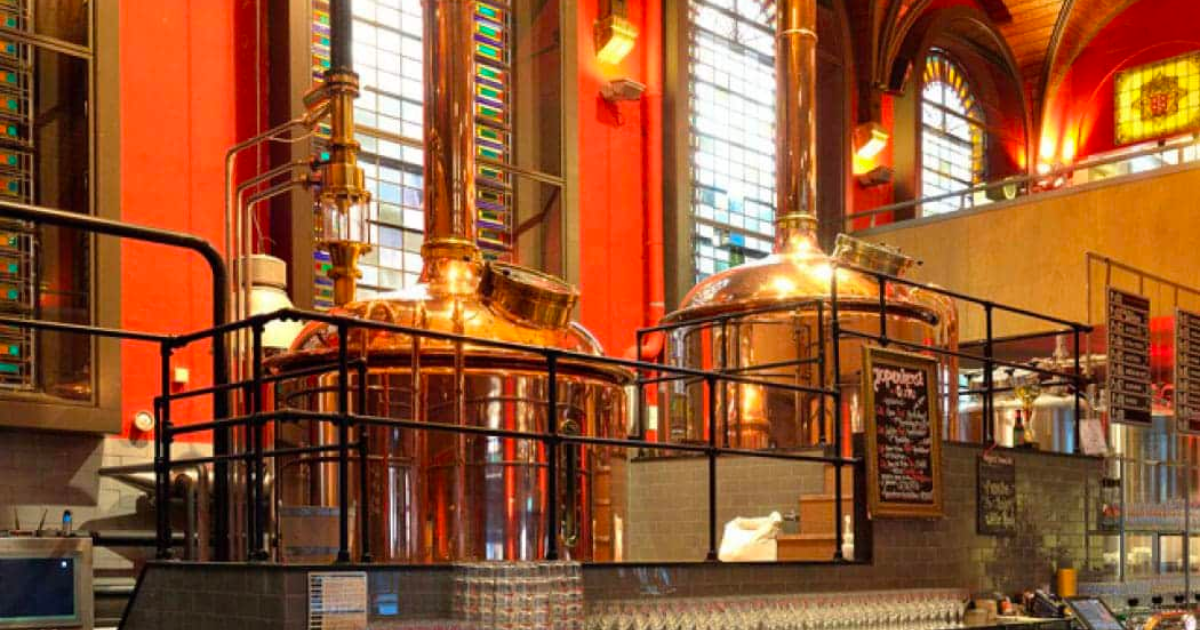
At Haarlem’s Jopen brewery we enjoyed High Beer, their version of High Tea, sampling flights of beers (alc and non-alc alike), with some brewed based on centuries-old recipes. The brewery itself is within an old church and the soaring stained glass windows make it unlike any brewery you’ve ever seen.
While their drinking history is rich and fascinating, today’s typical Amsterdammer is looking forwards, not backwards. Except for a brief Covid-driven rise from ‘20 to ‘21, per capita consumption of alcoholic spirits in the Netherlands has generally been on the decline for decades. Anecdotally, that mirrors our experience. Non-alc beers from Jopen, Brouwerij ‘t IJ, Lowlander, To Øl, and more were readily available everywhere we ate and drank. In Oosterpark on a Saturday afternoon, we saw a fair bit of cannabis use but comparably little alcohol being consumed.
Thankfully, consumer demand for alcohol alternatives in the Netherlands is finding an abundance of options supplied by established brands like Fluere and Damrak, countless breweries, new upstarts like Kever, and more.
Which brings me back to Lucas Bols. The leaders of other very old companies (across all industries) are often reluctant to embrace change for fear of cannibalizing their existing revenue streams. Bols, however, seems to be more focused on what it’ll take to be successful in the next century than they are on what has worked for the prior four. Here’s to Bols and all those looking forwards.