The category’s default narrative is that younger consumers aren’t drinking like they used to, and many brands have focused their formulation and positioning accordingly. Gallup’s August data points to another group eschewing booze. Drinking fell eight points since 2023 among adults 18 to 34 and among adults 35 to 54. It also fell six points among adults 55 and older, from 61% to 55%. And, as economic pressures increase price scrutiny across industries, the 55+ set—which holds roughly 70% of U.S. household wealth, per the Federal Reserve—looks even more attractive.
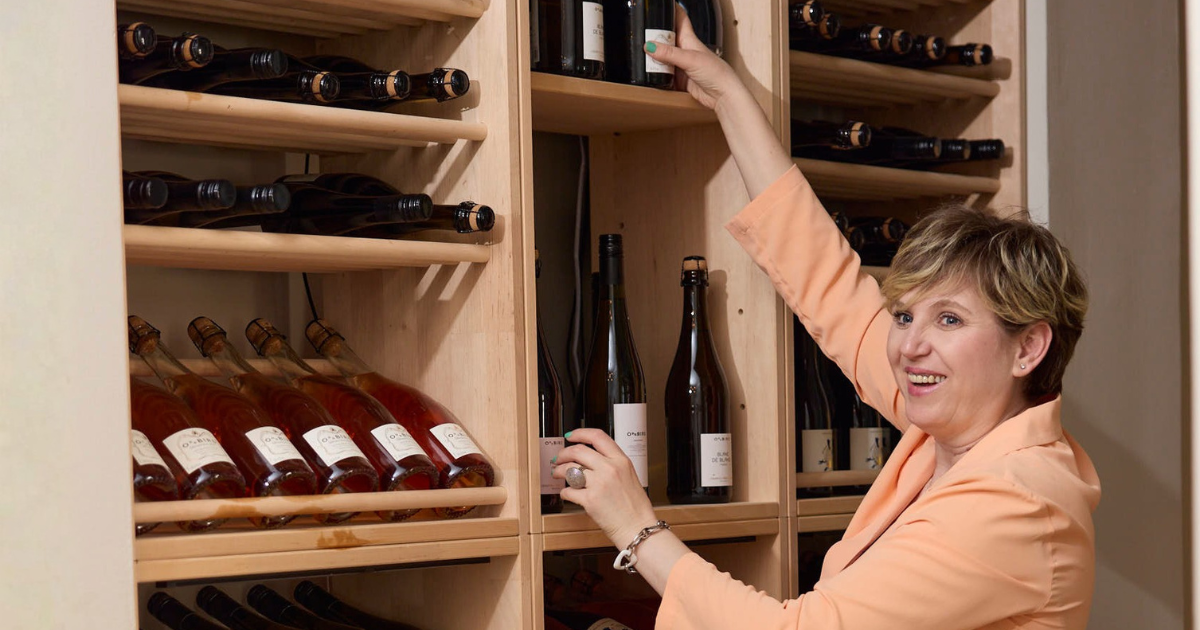
Two operators sell to that buyer every day. Mary Bernuth co-founded Pharos Brands, maker of a hemp THC sparkling beverage, with Rhyno Stinchfield; both are in their seventies and built it for their own age group. Kristin Patrick co-founded Orangily, a non-alcoholic bottle shop with locations in Carmel and Indianapolis, where the 55+ customer is a core buyer. Here’s what they’ve learned about how that buyer purchases.
They want the analog, and they want it bold
“As far as wine, they want direct, one-to-one analogs,” Patrick says. “Wine labeled ‘red blend’ or ‘sparkling white,’ where there isn’t a clear counterpart, typically doesn’t perform well for us.” Spirits run the same way: “Many 55+ shoppers seeking a zero-proof whiskey are disappointed in the weak taste. They want the bold punch a whiskey delivers.” Her top sellers to the cohort are French Bloom, Ariel Cabernet Sauvignon, The Pathfinder, Dromme Calm, and Free Spirits Bourbon.
Bernuth formulated for the same demand. “When someone has enjoyed wine or cocktails for 30 or 40 years, you can’t expect them to replace that ritual with something that feels like a compromise.” Pharos uses real fruit juice plus fruit oils and extracts so that “the fragrance of the fruit should reach your nose before the beverage even hits your lips.” Its Black Cherry, she says, “reminds me of a deep, rich red wine,” and the company reports a Gold for that flavor and a Double Gold for Mango at the WSWA competition. The lighter, sweeter profile that reads as approachable to a 28-year-old reads as a compromise to a 62-year-old.
Validation comes from restaurants and travel
“Knowing that a highly regarded restaurant carries a particular bottle of [non-alc] wine carries some weight,” Patrick says. She cites Bolle Reserve Chardonnay on the list at Vida, an award-winning restaurant in downtown Indianapolis, as a reason it sells in her store. Travel is the other reference point: “We receive many requests for products discovered while traveling in Europe and abroad. These are typically difficult to order. Translation: if it’s cool in Europe…” French Bloom, she adds, sells exceptionally well on its packaging and because it’s produced in France.
Bernuth calls it trust. “The biggest misconception is that we’re somehow finished discovering things. We’re not. People over 55 still entertain, travel, go to dinner, celebrate, try new products, and think about their health and wellness. But we’ve also had enough experience to know what we like, so brands have to earn our trust.” The sampling program for this buyer is a wine list at a restaurant they already book.
Discreet labels, familiar doors
Asked about the older host, Patrick says, “We intentionally choose packaging that doesn’t scream non-alcoholic. They don’t want ‘zero’ in huge letters across the label. The more discreet the labeling, the better.”
Pharos made the same call on channel. Matt Smith, who became CEO in August after 15 years in PepsiCo’s beverage division, says: “If we’re trying to reach someone in their 60s or 70s, I don’t want the first hurdle to be figuring out an unfamiliar purchasing channel. I want to meet them where they’re already comfortable shopping.” The company reports growth from 74 to 401 retail doors, including 20 to 127 ABC Fine Wine & Spirits locations in Florida, through licensed alcohol distributors rather than a cannabis-specific channel. Retailers are not asking for 55+ products by name, Smith says, since “the category is still too young for that.” They’re asking for “products that can bring incremental consumers and occasions into the adult beverage aisle.”
Distribution, in Smith’s words, “solves access, not understanding.” Pharos is launching Compass, an education program taken directly into 55+ communities that covers THC alongside adaptogens, mushrooms, and nootropics, built around a “Know Your Can” checklist: what is in it, how much, what it’s meant to do, when to ask a physician or pharmacist. “We’re not trying to convince older adults to consume cannabis,” Bernuth says. “We’re giving them enough information to make an informed decision for themselves.” A functional non-alc spirit with an adaptogen on the label has the same problem. This cohort will not buy what it can’t explain to its doctor.
The buyer the defaults miss
Orangily is two stores in one metro. Pharos is a THC beverage, so its channel lesson travels further than its product lesson does. Still, these are useful cases. The operators describe a buyer that the category has overlooked with its own defaults. The profile is built for a younger palate, the label is built to announce what’s missing, and the channel is built for a shopper willing to learn a new store. The buyer they miss is the one least sensitive to what’s on the price tag: Orangily’s best seller to the cohort is French Bloom, a bottle that retails near $40. That 62-year-old who drank Cabernet for 30 years wants the Cabernet, a bottle she can put on the table without explanation, and a store she already walks into.